
I thought Santa was real until I was 11. Where I’m from, he was called “Father Frost.”
My mom did great at lying to me. She said, “Anyone who tells you Santa isn’t real just wants to spoil the holidays for you.”
In Russia, we celebrate New Year’s Eve instead of Christmas. One New Year’s, I was five, and I saw Father Frost’s tail. It looked like a garland for the Christmas tree. Father Frost was running up the stairs, trying to hide. But I spied his sparkly tail in the light of our fireplace.
After that, nothing could convince me that Father Frost was a lie. “Your parents are Father Frost,” said my friend outside of class. I laughed at her, nervously. “Think whatever you want,” I said, “but I saw him.”
It was a sin to believe in Santa.
At least, this is what William Clifford wrote in 1877. He said,
It is wrong always, everywhere, and for anyone, to believe anything upon insufficient evidence. (William K. Clifford, The Ethics of Belief, p. 5).
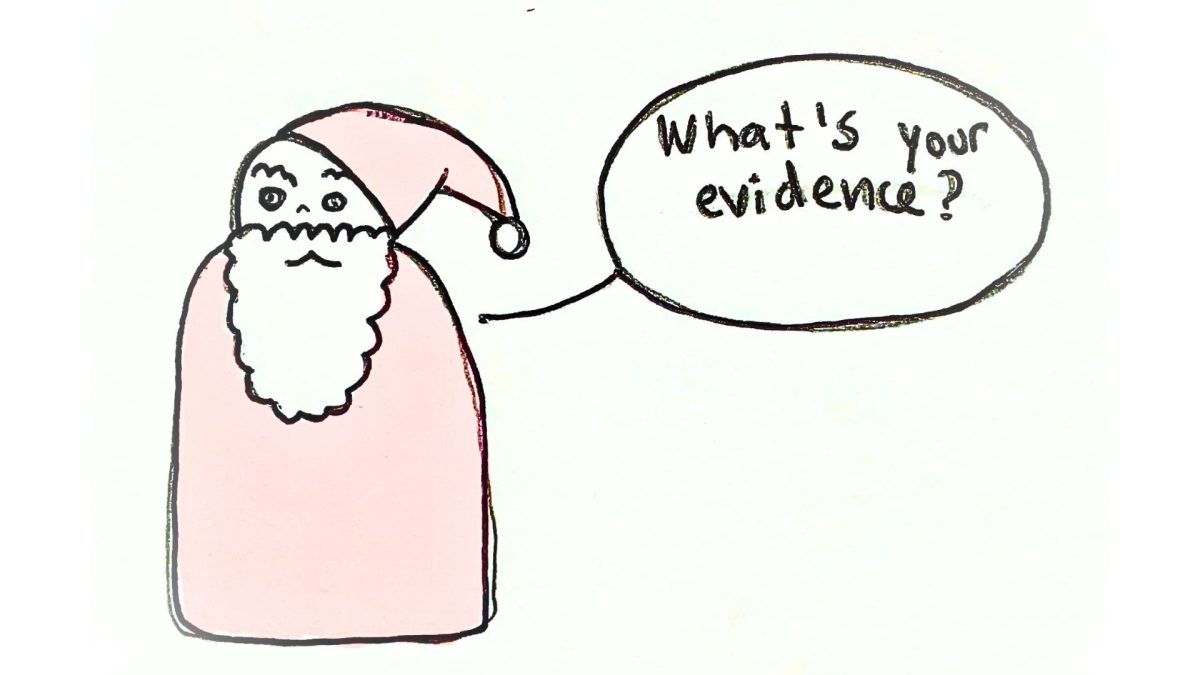
The evidence I had for believing in Father Frost was insufficient.
This was my evidence:
- If my mom says something, it is probably true.
- If I see something with my own eyes, it probably exists.
- I saw something sparkly, and my mom said it was Father Frost.
Therefore, I figured, Father Frost exists.
This “figuring” in philosophy is called “making an inference.”
From bullet point one, I made an inference from authority. Little did I know that what my mom says is not always true. I committed a fallacy called appeal to inappropriate authority.
From bullet point two, I made an empirical inference. That means I concluded something based on observation. Empirical inference is OK, but I moved from observation to believing my mother’s explanation for it. The conclusion “it was Father Frost” was unjustified.
I ended up with a belief that was based on insufficient evidence. This is what Сlifford had to say on that:
If the belief has been accepted on insufficient evidence… not only does it deceive ourselves by giving us a sense of power which we do not really possess, but it is sinful (p. 4, bolding is mine).
This is because holding false beliefs hurts society. It erodes the social rule “you shall check your evidence.” So, I sinned by believing in Father Frost.
I’m kidding.
My mother was the real sinner. Clifford wrote:
Every hard-worked wife of an artisan may transmit to her children beliefs which shall knit society together, or rend it in pieces (p. 4).
Children don’t have much influence on society, so it’s okay if they believe in Santa for a bit. But adults do.
Adults believe without sufficient evidence all the time (Kahan DM. Ideology, motivated reasoning, and cognitive reflection. Judgment and Decision Making, 2013). That’s because we’re afraid of disappointing others.
Say, Mimi, 45, believes that global warming isn’t real because everyone in her church does. If she starts to question this, her priest will call her a bloody alarmist and kick her out. Easier to keep believing global warming isn’t real. Mimi’s a sinner, says Clifford, though she goes to church. She is harming society by believing something without a good reason.
Serge, 22, on the other hand, believes that global warming is a thing because his classmates in college go out to protest it. He didn’t check with meta-analyses of scientific studies. He just trusted the crowd. Serge’s a sinner, too.
Anyone who believes without good evidence is doing wrong. Even if this belief happens to be true. Even if they never act on it. This is because they destroy the societal norm that everyone must have evidence for beliefs.
It is like stealing. Even if you steal from a guy who would never notice the money’s gone, it is still wrong, according to Clifford. This is because stealing destroys the societal norm, “you shall not steal,” and if we don’t have that norm, we’re screwed. More people will steal without shame. Likewise,
If we don’t have the societal norm “you shall not believe some bullshit you didn’t check,” we are screwed.
Clifford argued that believing without evidence is so wrong that it is a sin. People might die because of your false belief, for example, if you support a dangerous policy.
Believing in Santa is OK when you’re five. But for adults, believing without evidence is bad.
It’s hard to research every old thing you want to have an opinion on. But then we have to grind our teeth, collect our willpower, and admit we don’t know.
How does a zipper work?
— I don’t know.
How do you find a job in marketing?
— No idea.
What hairstyle should my best friend Cary get?
— Ask Cary, maybe.
What economic policy is the best for increasing revenue for tattoo artists?
— How would I know?
Some things, I would just research on Google Scholar. Like, I’d study economics for tattoo artists. But I can’t research EVERYTHING. And that means I can’t have an opinion on everything.
Clifford’s take sounds crazy. Am I a sinner for thinking it will rain tomorrow without checking with the weather app? “Sinner” is too much. But, in my (sufficiently justified) opinion, you are wrong if you believe a thing just because it brings you comfort. You should either suspend your belief (“I don’t know”) or sit down for an evening and research it in peer-reviewed journals. Our library has free access to peer-reviewed articles, FYI.
I thought it was OK to eat fish but not cows. Fish are smaller and look less like us, so they probably don’t feel pain like us, I thought. But I did not know that, I just wanted to believe that. So that I could eat my salmon.
Think of one opinion you’ve been doubting but couldn’t give up. Look up one peer-reviewed study about it. Write it down in your notes.
Congrats, you’re not a sinner.
This was an opinion column about philosophy. If you like thinking like this, take a philosophy class next semester. If you like that, declare a major or a minor.