


Getting across campus is a lengthy yet manageable hike. You can either beeline down Rockwell Road or meander around the dormitories and concrete masses of the plaza.
Rain, snow, or heat, we accept the walk to class. Talk to a friend, listen to some tunes and enjoy the fresh air. But for some students on campus, it’s all about speed.
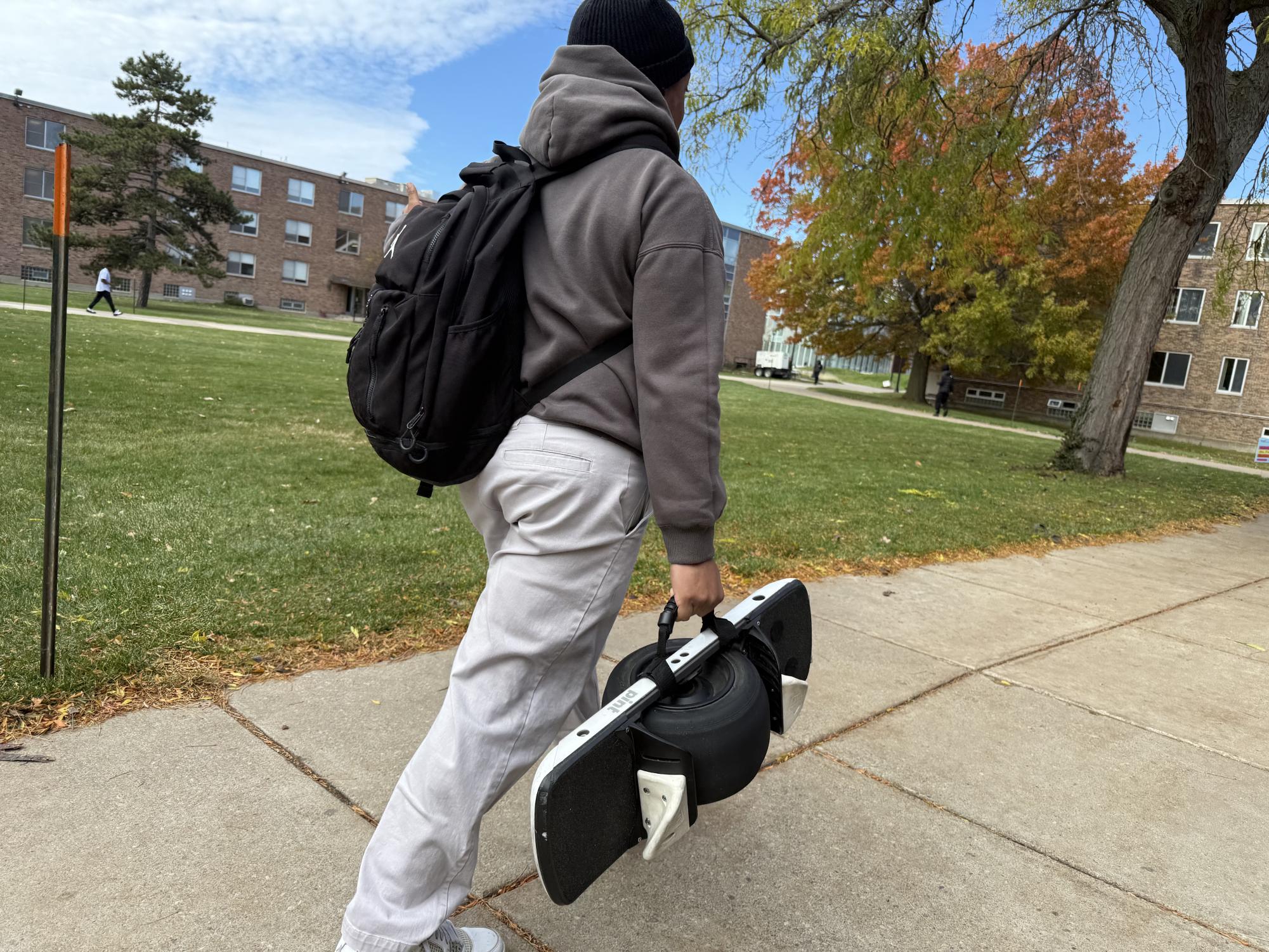
Self-balancing electric personal transporters, better known as Onewheels, are not only a growing phenomenon at Buffalo State, as more and more of our classmates whiz past us like flies at speeds of up to 15 mph, but all around the world. According to Future Motion, the creators of Onewheel, riders logged 50 million miles in 2024, doubling all-time ridership from 2014 to 2023.
Onewheels are like an electronic skateboard. Users balance on the board and lean forward or backward, engaging the wheel to spin in that direction. The lithium-ion battery-powered boards reach speeds anywhere from 12 to 25 mph, depending on the model.
The hobby’s entry fee isn’t cheap, with prices ranging from $750 to $3500 based on the board.
Taj Johnson, a junior at Buffalo State, became enthralled with Onewheeling after being gifted a hand-me-down from a friend.
“I’ve been using the same tire for like two years now,” Johnson said. “It has like 1,600 miles on it.”
He gets around campus, turning heads of both students and faculty. Without the need for any official permits from the school, riders can traverse across campus freely as long as they follow the rules. The university’s low-impact wheeled vehicle policy replicates New York State Vehicle & Traffic Law, stating that operators must adhere to the speed limit of 15 mph.
“This only goes 14 [mph], it gets me from point A to point B,” Johnson said. “Once you go past 14, it beeps, and it slows me down, and I can’t go any faster than that.”
Aside from a few concerned callers, the Buffalo State University Police Department (UPD) hasn’t had problems with riders. The policy was established on Oct. 25, 2024, but it wasn’t due to a recurring or specific issue on campus.
“New laws from the state started to be implemented,” UPD Officer William Ginnick said. “Riders aren’t allowed to do whatever they want.”
The state grouped methods of transportation like biking, skateboarding, and onewheeling into this low-impact wheeled vehicle policy. UPD wants riders to know the rules and the importance of following them to keep everyone safe.
“Everybody has to know their part,” UPD Officer Kevin Sullivan said. “They [riders] could be held liable in an accident.”
Safety is important for riders, pedestrians, and vehicles. According to a study by ERideHero, a consumer-centric, data-driven guide to electric rides, micromobility injuries among riders rose from 29,344 in 2020 to 115,713 in 2024, with 18.42% of the injuries in 2024 being head injuries.
“I definitely get a lot of comments because I don’t wear gear,” Johnson said. “I don’t really care for it, I feel like it is constricting.”
Onewheels are significantly faster than walking on campus. At an average pace of 115 steps per minute, it takes 4 minutes and 13 seconds to get from the Student Union to the bus stop on the corner of Elmwood Avenue and Rockwell Road. Nearly six times slower than a Onewheel.
“From the union getting down to the bus stop that’s probably 45 seconds,” Johnson said. “It just depends on the board and how fast it goes. This is a stock board, no upgrades, none of that.”
In 2015, most of us remember hoverboards, the two-wheeled balancing boards that anyone from Justin Bieber to your 12-year-old neighbor knew how to ride. That fad came and went, but Johnson believes that Onewheels are different.
“They’re definitely here to stay just because of how convenient it is,” Johnson said. “Hoverboards are more of just a toy, I can get to work with this.”
Across town, the University at Buffalo (UB) has prohibited all hoverboards, other electronically operated ebikes, and skateboard/scooter devices anywhere pedestrians would walk, according to the university’s Student Code of Conduct.
“They’re not super common, but enough to see one or two whenever I’m on north campus,” Evan Chapman, a sophomore at UB, said. “Most of them just go between the road and sidewalks, taking whatever route is fastest to avoid people walking.”
With rules in place at UB, riders still find ways to get around on campus despite the university pushing them to the bike lanes.
“Riding around campus, I know I’m not going to hit anybody,” Johnson said. “It’s just about being aware, it’s like driving a car.”





Ann Laiose-Barton • Dec 5, 2025 at 4:28 pm
Interesting article and happy to see that the college monitors usage and has guidelines that are followed for everyone’s safety and well being. E-bikes have been a very controversial topic lately and I hope that each municpality can come up with their rules and laws like your college has to keep people safe when riding e-bikes.